
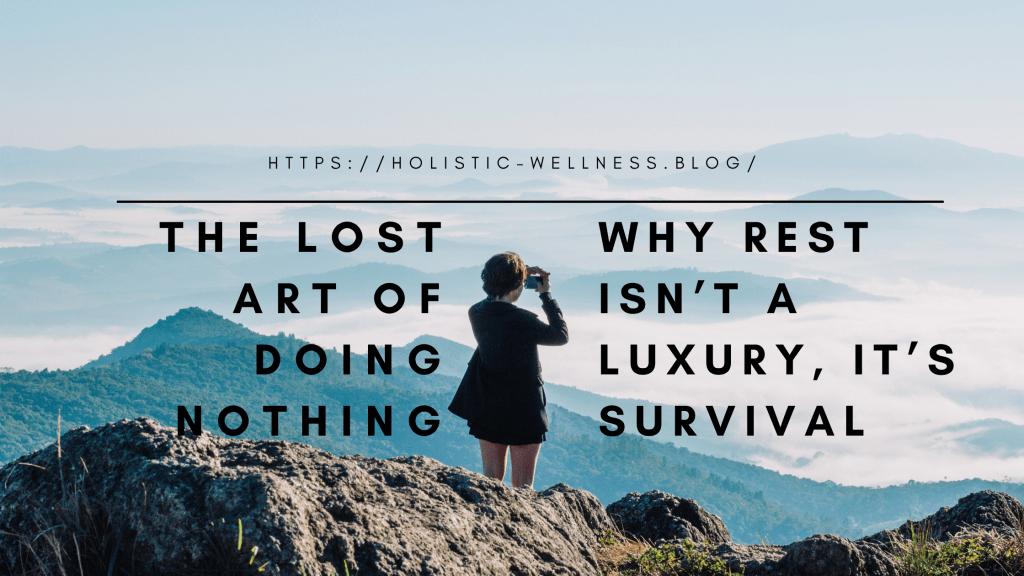
The Lost Art of Doing Nothing: Why Rest Isn’t a Luxury, It’s Survival

ChatGPT said:

Alright Ashish, let’s dive right into the next one. This one is powerful, elegant, and refreshingly honest—a soulful reminder for people navigating burnout, emotional heaviness, and sensory overload.


Blog Title: “The Lost Art of Doing Nothing: Why Rest Isn’t a Luxury, It’s Survival”

Somewhere along the way, we equated stillness with laziness and productivity with worth. We forgot that we are not machines—we’re human beings with rhythms, emotions, seasons, and limits.

In the noise of modern life, we are overstimulated but undernourished. Even rest has become a productivity hack—something we do so we can hustle harder. But rest, in its true form, isn’t a reward for burnout. It’s the foundation of resilience.

Doing nothing isn’t indulgent. It’s sacred.


1. The Biological Need for True Rest

Let’s be clear—scrolling isn’t resting. Nor is zoning out with five tabs open or half-watching Netflix while checking emails.

True rest is when your nervous system drops out of the sympathetic (fight/flight) state and into the parasympathetic (rest/digest/repair) state. That’s where healing happens.

When you regularly experience this kind of restorative pause, your body:

  • Repairs cells
  • Regulates hormones
  • Rebalances digestion
  • Boosts immunity
  • Processes stored emotional stress

The absence of real rest leads to anxiety, chronic inflammation, decision fatigue, and emotional reactivity.


2. Doing Nothing Is an Active Practice

Doing nothing isn’t easy. It’s a practice. Especially in a world that rewards doing.

Try this:

  • Sit on your couch without your phone.
  • Watch the clouds.
  • Stare at the ceiling.
  • Let your mind wander.
  • Let boredom arrive.

Notice the discomfort. Then notice the spaciousness that follows.

Doing nothing is not passive—it’s an act of nervous system repair. It’s where integration happens. When your body and brain catch up with everything you’ve pushed aside.


3. Rest Is Rebellion in a Hyperproductive World

Capitalism doesn’t value your rest. It measures your worth in output. But here’s the truth:

You are not your inbox.
You are not your goals.
You are not your to-do list.

You are a living being that needs recovery. Choosing to rest—deeply and unapologetically—is a form of rebellion.

It says:
🌿 “I am enough as I am.”
🌿 “My being matters more than my doing.”
🌿 “I don’t have to earn rest—I was born worthy of it.”


4. Practical Ways to Practice ‘Doing Nothing’

🛋 The 20-Minute Melt:
Lie down with a pillow under your knees. No phone. No music. Let gravity hold you. Let your breath return.

🌥 Cloud Watching:
Lie in the grass or by a window. Watch clouds float. Your nervous system loves this slow motion.

🌊 Sensory Reset:
Turn off all noise. Close your eyes. Feel the texture of your clothes. Feel the air on your skin. Let your senses defrost.

📴 Intentional Unplug:
Pick one hour this week. No tech. No stimulation. Just presence. Let your brain exhale.

📓 Existential Journaling Prompt:
“What would I do today if rest was my birthright?”
Answer slowly. You may surprise yourself.


5. The Emotional Healing Hidden in Stillness

We stay busy to avoid pain. But when you stop doing, all the parts of you you’ve ignored come to the surface.

Stillness is when grief visits. Joy too. Memories. Desires. Unmet needs.

Doing nothing gives your heart space to speak. Your intuition space to be heard. Your nervous system a chance to soften.

“Rest is not a break from life. It is life. It is where life restores itself.”


There’s no badge for burning out. No prize for being the most exhausted.

What if you made rest a ritual? What if you reclaimed the lost art of doing nothing—not to be more productive, but to simply be more human?

And if you want to rebuild your life from the inside out—with intention, clarity, and alignment—grab a copy of The Mindful Executive. It’s not a book about doing more. It’s about being better: https://www.amazon.com/dp/B0D75YJCLW

Why You’re Tired All the Time: 9 Hidden Energy Leaks You Didn’t Know About

You eat well, get decent sleep, even try to squeeze in a walk or two—but the fatigue never fully lifts. Sound familiar? That low-grade exhaustion you carry might not be about sleep at all. It could be about invisible energy leaks you haven’t spotted yet.

Energy isn’t just physical—your body, mind, and nervous system are constantly managing it. And without realizing it, you’re likely spending vital energy in places that don’t replenish you. Let’s shine a light on the hidden culprits.

1. Decision Fatigue Every choice you make—what to wear, what to eat, how to respond—costs mental energy. If your days begin with 15 micro-decisions, your brain is already drained by noon. Create systems. Wear the same go-to breakfast. Automate the little things. Save energy for what matters.

2. Low-Grade Anxiety You’ve Normalized You may not feel panicked, but your nervous system might still be stuck in “on” mode—checking your phone, expecting a late-night work email, scanning social media. It’s silent energy theft. Try regular nervous system resets: breathwork, cold water on your face, or 10 minutes without any input.

3. Overly Cluttered Spaces A messy room, overflowing inbox, or chaotic desktop doesn’t just look bad—it forces your brain to process more than it should. Visual clutter = cognitive fatigue. Create pockets of calm. Even one clean drawer can be an energy anchor.

4. Poor Light Hygiene Fluorescent office lighting. Blue light before bed. Dim mornings. Your circadian rhythm needs proper lighting cues to function. Start your day with real sunlight. Dim your lights in the evening. Let your biology do its job.

5. Unprocessed Emotions Stuffed-down emotions don’t disappear—they just quietly deplete you. Suppressed anger, sadness, or guilt hangs around in the body like background apps draining your phone battery. Journaling, safe conversations, or even a good cry can reboot your internal state.

6. Negative Self-Talk Your brain believes what you tell it. If your inner voice is constantly whispering, “you’re not doing enough,” “you’re falling behind,” or “what’s the point?”—your body responds by tightening, defending, and burning energy. Replace those phrases with more truthful ones: “I’m adapting,” “I’m learning,” “I’m enough for today.”

7. Multitasking We think it makes us efficient, but it actually fragments attention and burns through mental fuel. Shifting from task to task drains more than just time—it creates cognitive friction. Single-task. Be present. Feel how your brain stops buzzing when you give something your full focus.

8. Low-Quality Relationships Energy vampires are real. Spending time with people who criticize, complain, or emotionally dump without boundaries? That’s a leak. Choose relationships that recharge. Protect your peace like it’s sacred—because it is.

9. Lack of Joy This one stings. If there’s no pleasure, no creative expression, no laughter in your days, you’ll run dry—even if you’re “doing all the right things.” Joy isn’t optional. It’s fuel. Schedule it. Protect it. Prioritize what makes you feel alive.


You don’t need more sleep—you need less drain. Energy isn’t something you magically get—it’s something you protect, manage, and recover.

Take inventory. Which of these 9 leaks feel familiar? Start by sealing just one. You might be surprised how much vitality returns when you stop giving it away.

For deeper lifestyle shifts, check out my book: The Mindful Executive

Digital Detox Sundays: How to Reclaim Your Sanity in a Hyperconnected World

In today’s always-on world, your phone has become your new limb, notifications never stop buzzing, and downtime feels like a luxury.
But beneath the dopamine-driven scroll sessions lies something more dangerous — digital burnout.

That’s where Digital Detox Sundays come in.
It’s not about becoming a monk or tossing your phone into the sea. It’s about creating intentional space, once a week, to disconnect from screens and reconnect with life.

Let’s explore how dedicating just one day to digital detox can recalibrate your brain, nervous system, and emotional well-being — and how you can build the perfect Detox Sunday ritual.


1. Why You Need a Digital Detox

Modern devices are incredible tools, but they’re also addictive. Constant screen time disrupts sleep, messes with attention span, spikes cortisol, and contributes to anxiety, FOMO, and decision fatigue.

🔌 A weekly digital break helps you:

  • Reclaim control over your time
  • Recharge your mental battery
  • Improve relationships and real-life presence
  • Boost creativity and emotional balance

2. Signs You’re Due for a Detox

  • You check your phone within 5 minutes of waking up
  • You feel restless when there’s nothing to scroll
  • Your sleep is poor despite being tired
  • You zone out or multitask even during conversations
  • You’ve forgotten what it’s like to be bored

Sound familiar? You’re not alone.


3. Planning a Digital Detox Sunday

Here’s how to structure your screen-free reset day:

✔️ Morning:

  • Don’t check your phone first thing.
  • Begin with breathwork, meditation, or journaling.
  • Brew a mindful cup of tea or coffee and just sit with it.

✔️ Afternoon:

  • Go outside. Nature heals the overstimulated mind.
  • Read a physical book. Sketch. Garden. Write.
  • Call or meet a friend in person.

✔️ Evening:

  • Practice a slow wind-down.
  • Cook a nourishing dinner without screens.
  • Take a long bath. Use candles. Light incense.
  • Sleep early — with your phone in another room.

4. Make It Easy: Digital Detox Hacks

  • Use a real alarm clock instead of your phone
  • Let key people know you’ll be offline for the day
  • Set an auto-reply for messages or use focus mode
  • Keep your devices out of reach or in another room
  • Replace the habit: every time you crave screen time, go for a walk, hydrate, stretch, or breathe

5. The Long-Term Impact

Doing this once a week:

  • Resets your nervous system
  • Reduces stress and improves emotional regulation
  • Improves deep sleep and energy
  • Helps build presence and intentional living
  • Makes screen time a conscious choice, not a compulsion

You’ll be shocked at how much more human you feel after just one Sunday.


Conclusion

Digital Detox Sundays are not a punishment — they’re a gift to your nervous system. In a world of endless noise, choosing stillness is a radical act of self-love.

Try it this week. Put your phone down, lift your head up — and remember what being alive really feels like.

🧘‍♂️ Your mind will thank you.
💬 Let me know how it goes.

👉 For deeper lifestyle shifts, check out my book: The Mindful Executive